Powered by Blogger.

Healthy Eating

Eating Based on Food Pyramid


Healthy Eating Pyramid  Guidelines :

 
Daily Exercise & Weight Control
 
The Healthy Eating Pyramid has a picture of “Daily Exercise and Weight Control” on its base, showing that these two related elements strongly influence your chances of staying healthy. They also affect what you eat and how your food affects you. Exercise and weight control are also linked through the simple rule of energy balance; that you will gain weight if you eat more than you burn. By exercising regularly it will help you control your weight and it is the key part of any weight loss effort.

Vegetables and Fruits

Vegetables and fruits take up a big section of the food pyramid, showing their importance. Vegetables and fruits are rich in colour and taste. They add variety to your diet and are a feast for the eyes, but they can do even more for you. By eating a lot of vegetables and fruits everyday you will gain the possibility to stay healthy throughout your life. You will create a beneficial habit that may: lower your blood pressure, reduce your risks of having cardiovascular diseases and cancer, protect you from losing your vision when you are getting older and also help you from having diverticulitis (intestinal ailment).

Healthy Fats and Oils

The Healthy Eating Pyramid puts the fats and oils near the base which is a bit different and unconventional if you compare to other food pyramids, but it makes sense. They are inline with the evidence: unsaturated fats are healthy fats. They don’t improve cholesterol levels and they can protect against heart problems. Putting the fats and oils near the base is also in line with common eating habits since the average American gets about one-third of its daily calories from fat. This is why it is so important to eat healthy fats. Healthy fats can be found in vegetable oils, nuts, seeds, avocados and fatty fish like salmon.

Whole Grains

You need carbohydrates for energy and whole grain is the best source, which the food pyramid illustrates. Research suggests that we should eat a diet rich in whole grains because it helps controlling our blood sugar and insulin levels from rising and falling too quickly. The reason for this is that the body can’t digest whole grains as quickly as with processed carbohydrates such as white bread. By eating whole grains you won’t feel hungry that often, which will have a positive effect on your weight. It may also prevent the development of type 2 diabetes and protect you against heart diseases. Whole grains can be found in oatmeal, whole bread and brown rice.

Nuts, Seeds, Beans and Tofu
The Healthy Eating Pyramid shows the importance of eating nuts, seeds, beans and tofu. They are all rich in protein, fibre, vitamins and minerals. Many kinds of nuts contain healthy fats and vitamin E. Research has even suggested that they are good for your heart especially: almonds, walnuts, pecans, peanuts, hazelnuts, and pistachios.

Fish, Poultry and Eggs

Fish, poultry and eggs are included in the food pyramid because they are rich in protein. Chicken and turkey are also good sources of protein and are low in saturated fat. Research suggests that you can reduce the risk of heart disease if you eat fish rich in omega-3 fats. Salmon, trout and herring are especially high in omega-3 fatty acids. Eggs have been said to be bad for your health because they are high in cholesterol, but if you compare it to a doughnut made from refined flour and cooked in oil (rich in trans fat), eating an egg for breakfast is a much healthier alternative. If you have diabetes or heart disease you should not eat more than 3 eggs (egg yolk) a week. The egg whites are fine though; they are rich in protein and a fine substitute in omelettes and baking.

Dairy (1 to 2 servings per day) or Vitamin D/Calcium Supplements

If you want to grow and have strong bones you need Vitamin D, Calcium and exercise, according to the Healthy Eating Pyramid. You will get most of vitamin D and Calcium from your dairy but sometimes it’s not enough. For example: If you drink one glass of milk you will get 100 IU (International Units) of vitamin D but you need at least 1,000 IU every day. The answer to that problem should logically be to drink more milk or eat more dairy products, but if you drink three glasses of whole milk you will get as much saturated fat as 13 strips of cooked bacon! So what is the solution if you want to stay healthy and in control of your weight? How can you get enough vitamins and minerals without getting too much of the unhealthy saturated fat? The solution to this dilemma is to stick to no- or low-fat dairy products. If you don’t get enough vitamin D and Calcium from the dairy products, you should consider taking vitamin D and calcium supplement, according to Healthy Eating Pyramid.

Use Sparingly: Red Meat and Butter

To the left at the top of the Healthy Eating Pyramid you will find red meat and butter. It has the smallest section of the food pyramid because you should eat less red meat and butter. Red meat and butter contain lots of saturated fat and may increase your risk of colon cancer. Instead, if you switch to eating fish, chicken or beans more often and switch from butter to olive oil, it can improve your cholesterol levels as well as the overall condition of your heart health, according to Healthy Eating Pyramid.

Use Sparingly: Refined Grains (White Bread, Rice, Pasta), Potatoes, Sugary Drinks, Sweets, Salt

The reason why refined grains, potatoes, sugary drinks, sweets and salt are placed at the top of the Healthy Eating Pyramid (together with red meat and butter), is that you should eat/drink very little of this kind of products. They increase blood sugar levels, making you feel hungry quickly with the results that you eat more and gain more weight. It may also cause diabetes and other chronic disorders. A new addition to the Healthy Eating Pyramid is that it says “Use Sparingly” next to the salt shaker. Research has found that high-sodium diets increase risk of health problems causing heart attack and stroke.

Multivitamin with Extra Vitamin D (for most people)

If you look to the left of the Healthy Eating Pyramid you will find a bottle of multivitamin and multimineral supplement, emphasizing vitamin D. It is not suggested to replace a healthy diet, rather fill in the nutrient holes that sometimes occur.
There are supplements that don’t cost a lot of money that will do just fine. Look for a multivitamin that meets the requirements of the USP (U.S. Pharmacopeia), an organization that sets standards for drugs and supplements. Then look for the standard RDA-level (Recommended Dietary/Daily Allowance) which will be enough for most nutrients, except for perhaps vitamin D. Vitamin D is important for your bones and new research even suggest that some extra vitamin D (1,000 IU per day) can help lower the risk of colon and breast cancer. People who live in the northern parts during winter or have darker skin will need extra vitamin D (3,000-4,000 IU per day). If you are unsure, ask your doctor to check your blood level.

Optional: Alcohol in Moderation (not for everyone)

A bottle of wine is placed next to the food pyramid to point out that consumption of alcohol is optional. According to studies the risk of heart diseases may reduce if you have a moderate amount of alcoholic drink. In general however, the risks of drinking, even in moderation, exceed benefits until middle age. Women should avoid alcohol during pregnancy.


  • Digg
  • Del.icio.us
  • StumbleUpon
  • Reddit
  • RSS

The Different Types of Relationships Among the Living Organisms in Biosphere

Type of Organisms and their Relationships

Many ecosystems have different types of Species those have different manners of interrelationship among them. These species interact with each other to establish a stable ecological balance. These types of relationships may be of interspecific or intraspecific categories. Different types of associations are discussed below :

a) Saprotropism: In this type of association one type of organism is living, where other is dead organic matter. Living organisms grow on the dead and decaying organic bodies like wood, bread, lemon etc. and take their nutritive elements from those dead organic materials. Saprophytic nutrition is found in non-green plants which draw their nourishment from dead matters. Saprophytes may be of two types : Total and Partial.
Total saprophytic plants completely depend on the dead and decaying substances for nutrition. E.g. Mucor, Agaricus.

b) Antagonism: In this type of interaction either one or both type of organisms are harmed. This association is subdivided into following categories :

1. Parasitism: In this type of relationship one type of organism is benefited and other is harmed. In this category of heterospecific association one organism (Parasite), lives at the expense of other associated organism (Host). Among plant kingdom Dodder (Cuscuta reflexa) collects its nutritive elements fro the host plant with the help of sucking root called Haustoria. Among kingdom Animalia two types of parasites are found : Ectoparasite (living outside the host body) and Endoparasite (living inside the host body). Round worm is an ectoparasite living inside the human small intestine and draw nutrition as endoparasite but Louse is an ectoparasite at it lives outside the human body i.e. on the outer body surface.

2. Exploitation : In this type of relationships one organism enslaves the other organism.

3. Predation : In this type of association one organism catches and kills the other type of oraganism and take it as food. As Tiger catches deer, Pitcher plant catches insects for their food, Human catches fishes.

4. Ammensalism or antibiosis : In this type the chemical secretion of organism's body harms the another but no nutrition takes place. The chemical secretion is called Antibiotic. Penicillin is an antibiotic produced from the fungus Penicillium notatum that kills the bacterium Staphylococcus bacterium.

5. Competition : In this type of nutrition two organisms when living in a specific ecosystem compete with each other for food and shelter.

6) Symbiosis : In this type of relationship living organisms live together and help one another. It is mainly of three categories :

1. Commensalism : In this type of association one organism may be benefited and other may remain neutral but no one is harmed. Fireasfer fish lives inside the cloacal cavity of Sea cucumber to protect itself from the attack of predators. Here no one is harmed, but Fireasfer fish is protected. So, it is an example of commensalism relationship between them.

2. Mutualism : It is an obligatory relationship between two organisms where both of the individuals are benefited by each other and they are physiologically inter-dependant with each other. The association between the algae Zoochlorella and Hydra is an example of mutualism where both are benefited by each other. Lichen is the result of a union between a green alga and a fungus. The fungus gains oxygen and carbohydrates from the alga and the alga obtains water carbon dioxide and mineral salts from the fungus.

3. Protocooperation : this is an facultative relationship between two organisms where both the individuals are benefited by each other but they can also live independently. Association between hermit crab and sea anemone is an example of  Protocooperation.

4) Neutralism : This is one type of relationship between/among two or more type/types of organism/organisms where they live together but neither they are benefited nor harmed. In the freshwater bodies this type of relationship is found between Hydra and Phytoplankton.

GLOSSARY FOR HELPING THE READERS :
1. Intraspecific : between/among same species.
2. Interspecific : between /among different species.
3. Organic : related to living body.
4. Nutritive elements : substances required for the purpose of nutrition of organisms.
5. Heterospecific : between/among different organisms.
6. Kingdom Animalia : animal kingdom.
7. Pitcher plant : an insectivorous plant.
8. Cloacal cavity : a part of alimentary canal contains faecal elements.
9. Alga : singular form of algae.

  • Digg
  • Del.icio.us
  • StumbleUpon
  • Reddit
  • RSS

Reproductive System

Reproductive system in Animals

Animals’ reproductive systems can be divided into the internal reproductive organs and the external genitalia. The gonads are the actual organs that produce the gametes. In the male, testes (singular = testis) produce sperm, and in the female, ovaries make eggs.
In most animals, individuals are either definite males or definite females. However, in some species, individual organisms are both male and female. Hermaphroditism is when one organism has both sexes. Earthworms and garden snails always have both male and female organs, and when, for example, two earthworms mate, they fertilize each other. A special variation on the theme is sequential hermaphroditism, in which an organism changes sex during its life. If an organism is female first and later changes to male, that organism is protogynous, and if the organism is male first and changes to female, it is said to be protandrous. In different species, sequential hermaphroditism can be influenced by the organism’s age or size or by various environmental/climatic factors.
While most higher animals reproduce sexually, there are some species in which the females can, under certain conditions, produce offspring without mating. Parthenogenesis is the ability of an unfertilized egg to develop and hatch. This seems to be especially prevalent among insects. Some of the giant walkingsticks at the Zoo are females who, without mating, lay eggs that hatch into more females generation after generation. Other insects, like some aphids, have complicated life cycles that involve sexually-reproducing generations alternating with parthenogenically produced generations. In honeybees, fertilized eggs turn into females (workers and queens), while unfertilized eggs, which are only produced in the spring, turn into males.
In sexual reproduction, there must be some way of getting the sperm to the egg. Since sperm and eggs are designed to be in a watery environment, aquatic animals can make use of the water in which they live, but terrestrial animals must, in some way, provide the wet environment neeeded for the sperm to swim to the egg. There are, thus, two major mechanisms of fertilization. In external fertilization, used by many aquatic invertebrates, eggs and sperm are simultaneously shed into the water, and the sperm swim through the water to fertilze the egg. In internal fertilization, the eggs are fertilized within the reproductive tract of the female, and then are covered with eggshells and/or remain within the body of the female during their development.
In species with external fertilization, at an appropriate developmental stage, the eggs hatch, and the new young simply swim away. However, females of species with internal fertilization must, at some point, expel the growing young. There are three general ways of doing this:

  • Oviparous organisms, like chickens and turtles, lay eggs that continue to develop after being laid, and hatch later.
  • Viviparous organisms, like humans and kangaroos, are live-bearing. The developing young spend proportionately more time within the female’s reproductive tract, portions of which are specially-modified for this purpose. Young are later released to survive on their own.
  • Ovoviviparous organisms, like guppies, garter snakes, and Madagascar hissing roaches, have eggs (with shells) that hatch as they are laid, making it look like “live birth.”

Reproductive System in Humans :

1. Male Reproductive System :

The male reproductive system is illustrated to the right. Sperm are produced in the testes located in the scrotum. Normal body temperature is too hot thus is lethal to sperm so the testes are outside of the abdominal cavity where the temperature is about 2° C (3.6° F) lower. Note also that a woman’s body temperature is lowest around the time of ovulation to help insure sperm live longer to reach the egg. If a man takes too many long, very hot baths, this can reduce his sperm count. Undescended testes (testes are supposed to descend before birth) will cause sterility because their environment is too warm for sperm viability unless the problem can be surgically corrected.
From there, sperm are transferred to the epididymis, coiled tubules also found within the scrotum, that store sperm and are the site of their final maturation.
In ejaculation, sperm are forced up into the vas deferens (plural = vasa deferentia). From the epididymis, the vas deferens goes up, around the front of, over the top of, and behind the bladder. A vasectomy is a fairly simple, outpatient operation that involves making a small slit in each scrotum, cutting the vasa deferentia near where they begin, and tying off the cut ends to prevent sperm from leaving the scrotum. Because this is a relatively non-invasive procedure (as compared to doing the same to a woman’s oviducts), this is a popular method of permanent birth control once a couple has had all the children they desire. Couples should carefully weigh their options, because this (and the corresponding female procedure) is not designed to be a reversible operation.
The ends of the vasa deferentia, behind and slightly under the bladder, are called the ejaculatory ducts. The seminal vesicles are also located behind the bladder. Their secretions are about 60% of the total volume of the semen (= sperm and associated fluid) and contain mucus, amino acids, fructose as the main energy source for the sperm, and prostaglandins to stimulate female uterine contractions to move the semen up into the uterus. The seminal vesicles empty into the ejaculatory ducts. The ejaculatory ducts then empty into the urethra (which, in males, also empties the urinary bladder).
The initial segment of the urethra is surrounded by the prostate gland (note spelling!). The prostate is the largest of the accessory glands and puts its secretions directly into the urethra. These secretions are alkaline to buffer any residual urine, which tends to be acidic, and the acidity of the woman’s vagina. The prostate needs a lot of zinc to function properly, and insufficient dietary zinc (as well as other causes) can lead to enlargement which potentially can constrict the urethra to the point of interfering with urination. Mild cases of prostate hypertrophy can often be treated by adding supplemental zinc to the man’s diet, but severe cases require surgical removal of portions of the prostate. This surgery, if not done very carefully can lead to problems with urination or sexual performance.
The bulbourethral glands or Cowper’s glands are the third of the accessory structures. These are a small pair of glands along the urethra below the prostate. Their fluid is secreted just before emission of the semen, thus it is thought that this fluid may serve as a lubricant for inserting the penis into the vagina, but because the volume of these secretions is very small, people are not totally sure of this function.
The urethra goes through the penis. In humans, the penis contains three cylinders of spongy, erectile tissue. During arousal, these become filled with blood from the arteries that supply them and the pressure seals off the veins that drain these areas causing an erection, which is necessary for insertion of the penis into the woman’s vagina. In a number of other animals, the penis also has a bone, the baculum, which helps to stiffen it. The head of the penis, the glans penis, is very sensitive to stimulation. In humans, as in other mammals, the glans is covered by the foreskin or prepuce, which may have been removed by circumcision. Medically, circumcision is not a necessity, but rather a cultural “tradition”. Males who have not been circumcised need to keep the area between the glans and the prepuce clean so bacteria and/or yeasts don’t start to grow on accumulated secretions, etc. there. There is some evidence that uncircumcised males who do not keep the glans/prepuce area clean are slightly more prone to penile cancer.


2. Female Reproductive System

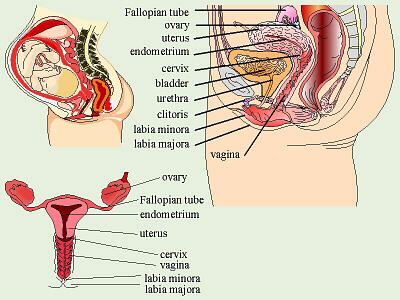
The female reproductive system is illustrated to the right. “Eggs” are produced in the ovaries, but remember from our discussion of meiosis, that these are not true eggs, yet, and will never complete meiosis and become such unless/until first fertilized by a sperm. Within the ovary, a follicle consists of one precursor egg cell surrounded by special cells to nourish and protect it. A human female typically has about 400,000 follicles/potential eggs, all formed before birth. Only several hundred of these “eggs” will actually ever be released during her reproductive years. Normally, in humans, after the onset of puberty, due to the stimulation of follicle-stimulating hormone (FSH) one “egg” per cycle matures and is released from its ovary. Ovulation is the release of a mature “egg” due to the stimulation of leutenizing hormone (LH), which then stimulates the remaining follicle cells to turn into a corpus luteum which then secretes progesterone to prepare the uterus for possible implantation. If an egg is not fertilized and does not implant, the corpus luteum disintegrates and when it stops producing progesterone, the lining of the uterus breaks down and is shed.
Each “egg” is released into the abdominal cavity near the opening of one of the oviducts or Fallopian tubes. Cilia in the oviduct set up currents that draw the egg in. If sperm are present in the oviduct (if the couple has recently had intercourse), the egg will be fertilized near the far end of the Fallopian tube, will quickly finish meiosis, and the embryo will start to divide and grow as it travels to the uterus. The trip down the Fallopian tube takes about a week as the cilia in the tube propel the unfertilized “egg” or the embryo down to the uterus. At this point, if she had intercourse near the time of ovulation, the woman has no idea whether an unfertilized “egg” or a new baby is travelling down that tube. During this time, progesterone secreted by the corpus luteum has been stimulating the endometrium, the lining of the uterus, to thicken in preparation for possible implantation, and when a growing embryo finally reaches the uterus, it will implant in this nutritious environment and begin to secrete its own hormones to maintain the endometrium. If the “egg” was not fertilized, it dies and disintegrates, and as the corpus luteum also disintegrates, its progesterone production falls, and the unneeded, built-up endometrium is shed.
The uterus has thick, muscular walls and is very small. In a nulliparous woman, the uterus is only about 7 cm long by 4 to 5 cm wide, but it can expand to hold a 4 kg baby. The lining of the uterus is called the endometrium, and has a rich capillary supply to bring food to any embryo that might implant there.
The bottom end of the uterus is called the cervix. The cervix secretes mucus, the consistency of which varies with the stages in her menstrual cycle. At ovulation, this cervical mucus is clear, runny, and conducive to sperm. Post-ovulation, the mucus gets thick and pasty to block sperm. Enough of this mucus is produced that it is possible for a woman to touch a finger to the opening of her vagina and obtain some of it. If she does this on a daily basis, she can use the information thus gained, along with daily temperature records, to tell where in her cycle she is. If a woman becomes pregnant, the cervical mucus forms a plug to seal off the uterus and protect the developing baby, and any medical procedure which involves removal of that plug carries the risk of introducing pathogens into the nearly-sterile uterine environment.
The vagina is a relatively-thin-walled chamber. It servs as a repository for sperm (it is where the penis is inserted), and also serves as the birth canal. Note that, unlike the male, the female has separate opening for the urinary tract and reproductive system. These openings are covered externally by two sets of skin folds. The thinner, inner folds are the labia minora and the thicker, outer ones are the labia majora. The labia minora contain erectile tissue like that in the penis, thus change shape when the woman is sexually aroused. The opening around the genital area is called the vestibule. There is a membrane called the hymen that partially covers the opening of the vagina. This is torn by the woman’s first sexual intercourse (or sometimes other causes like injury or some kinds of vigorous physical activity). In women, the openings of the vagina and urethra are susceptible to bacterial infections if fecal bacteria are wiped towards them. Thus, while parents who are toilet-training a toddler usually wipe her from back to front, thus “imprinting” that sensation as feeling “right” to her, it is important, rather, that that little girls be taught to wipe themselves from the front to the back to help prevent vaginal and bladder infections. Older girls and women who were taught the wrong way need to make a conscious effort to change their habits.
At the anterior end of the labia, under the pubic bone, is the clitoris, the female equivalent of the penis. This small structure contains erectile tissue and many nerve endings in a sensitive glans within a prepuce which totally encloses the glans. This is the most sensitive point for female sexual stimulation, so sensitive that vigorous, direct stimulation does not feel good. It is better for the man to gently stimulate near the clitoris rather than right on it. Some cultures do a procedure, similar to circumcision, as a puberty rite in teenage girls in which the prepuce is cut, exposing the extremely-sensitive clitoris. There are some interesting speculations on the cultural significance of this because the sensitivity of the exposed clitoris would probably make having sexual intercourse a much less pleasant experience for these women.


  • Digg
  • Del.icio.us
  • StumbleUpon
  • Reddit
  • RSS

Importance of Water in Diet

Water

Water.  Most of us take it for granted.  But have you every taken a moment to stop and think just how important water is to you?  For the human body, water is truly a vital resource.  You can go weeks without food but only 5-7 days without water.  When the water in your body is reduced by just 1 percent, you become thirsty.  At 5 percent, muscle strength and endurance declines significantly and you become hot and tired.  When the loss reaches 10 percent, delirium and blurred vision occur.  A 20 percent reduction results in death. 
 
There is no more important nutrient for our bodies than water.  No other substance is as widely involved in the processes and make up of the body.  A man's body is about 60 percent water, and a woman's is approximately 50 percent.  Did you know that the human brain is about 75 percent water? 
 

TissuePercent Water
Blood83.0
Heart79.2
Muscle75.6
Brain74.8
Skin72.0
Bone22.0
 
Every day, we lose 2-3 quarts of water through urination, sweating and breathing.  Since many of the processes within the body rely greatly on water, it is important we replace our fluids regularly to compensate for this loss. 

Importance of Water :

Water as a Solvent:  Water is the fundamental solvent for all biochemical processes in our bodies.  Because water is highly polar (has an unequal distribution of charge), it is an excellent solvent for other charged and polar molecules.  Haemoglobin, carbonates, various proteins, and many other molecules in the body use water as a solvent.

 
Water as a Transporter:  Once a substance is dissolved in water, water becomes very important for transporting it throughout the body.  Blood, which is 83 percent water, transports oxygen, CO2, nutrients, waste products, and more from cell to cell.  Urine is also mostly water. Another very important transporter, urine removes waste products from the body.  If we don't get enough water and can't produce enough urine, toxic levels of wastes build up in the body and we can become very sick or even die. 

Protection:    Water is needed for protection as well.  It keeps your mouth moist and washes away dirt and grim on your eyes.  Water even lubricates our joints, keeping them from getting stiff and making sure motion is smooth. 

  Chemical Reactant:   As a chemical reactant, water is involved in many processes and pathways of the body.  We use it to digest food in the gastrointestinal tract, to access stored energy for muscles and organs, and for countless other reactions.  Next, we will examine one of these reactions in detail and see how water helps regulate pH in the body.

pH regulation:    Our bodies must maintain a very specific pH level of 7.4.  pH values less than 6.9 and greater than 7.6 are life threatening so it is essential that we have ways to keep pH from deviating too far from normal.  Water is a reactant in a very important reaction that maintains pH at 7.4. 
Example:
This reaction takes place in the blood: 
CO2 + H20 <==> H2CO3< ==> H+ + HCO3
Can you see water's role?  If pH is too high (too few H+ ions), water reacts with carbon dioxide to create more H+ ions, lowering the pH.  A pH lower than 7.4 shifts the above reaction to the left, using up H+ ions, creating CO2 and H2O and raising pH.   It is important that this reaction go back and forth to maintain equilibrium.

 
Electrolyte Balance:    Water is very important in maintaining electrolyte balance within our bodies.  Electrolytes are charged ions (such as Na+ or Cl-) which must be kept at certain levels to maintain the proper amount of water in our cells.  Electrolytes transmit all sorts of information to our brains in the form of nerve impulses and are important in muscular activity as well.  To maintain electrolytes at the proper level in our cells, water flows in and out of the cell to make sure that these ions remain in balance.


Temperature Regulation  In our homes, the air conditioner keeps things cool.  But how does our body stay cool?  Well, we actually have our own natural air conditioning system.  Bet you can guess what it is...  That's right, water!  The most important way water regulates our body temperature is through sweat.  Our normal body temperature is 98.6 degrees Fahrenheit.  When you go outside in the sun, you'll probably begin to sweat in no time, especially if you're active.  But why does the body need to sweat?  Sweat is a way for the body to cool itself down.  When we sweat, it evaporates on our skin, drawing heat away from the body and cooling us down.

Exercise and Water:   When we exercise, water loss through sweat can reach 1-2L per hour!  If you are exercising in warm weather, water should be replenished every 15 minutes in order to keep muscles strong and body temperature down.  This is especially crucial for long endurance events, which is why cyclists (who strip away every unnecessary ounce of equipment) still carry water with them.  Water is vital in delivering oxygen to muscles and helps the body perform physical labour more efficiently.  Here are some graphs showing the effects of fluid replacement during exercise.  Can you guess which lines represent the people who were given water and which represent those who went without it?


  • Digg
  • Del.icio.us
  • StumbleUpon
  • Reddit
  • RSS

Cloning of Dolly The Sheep

About Dolly

Dolly, a Finn Dorset sheep, was born on July 5th, 1996, at the Roslin Institute in Edinburgh, Scotland. Her birth, not revealed to the public until February 3rd, 1997, sparked controversy instantly, because Dolly was the world's first mammal to be cloned from an adult cell. Considered one of the most significant scientific breakthroughs ever, Dolly's birth and subsequent survival proved that adult cells can reprogram themselves into a new being. The team that created her, led by Scotsman Ian Wilmut, hoped to create an animal whose cells were genetically young again, rather than prematurely adult; however, when Dolly was reported to have been euthanased on February 14th, 2003, nearly six years after her birth, concern was raised that her progressive lung disease was caused because her cells were already old; she also had premature arthritis. Sheep can normally live to 11 or 12 years of age, and lung disease is not common in younger sheep. There was some speculation as to whether she caught it or not from the other sheep that she was housed with, but that claim has been neither confirmed nor denied.

Dolly, named after singer Dolly Parton, bred normally on two occasions, with a Welsh mountain ram named David, and over the course of her life gave birth to four lambs; proving thus that clones can reproduce. Francis Crick and James Watson are widely recognized as some of the first pioneers in cloning technology. Their discovery of the double-helix structure  of DNA in 1953, and later, their work on moecular heredity, helped to propel the science of biotechnology into the public view. This in turn led to an increase in scientific research that focused on learning the intricacies of the human genetic code and, subsequently, the discovery that cloning is possible and within reach of scientists today. Cloning as it exists today would probably not exist but for the research of these two men, who in 1962 received a Nobel prize for their work. Another important name in cloning history is John Gurdon, who in 1962 announced that he had used the nucleus of fully differentiated adult intestinal cells to clone South African frogs. Gurdon’s experiment was widely talked about, although it was never proven that the frogs were true clones.
In 1984, Steen Willadsun cloned a sheep from embryo cells, which were the predecessor to Dolly’s method of cloning. His work was the first verified incidence of cloning using nuclear transfer, which was remarkable at the time considering that only a few months earlier it had been said that it was biologically impossible.
The major debate over Dolly was the issue of subsequent human cloning. The ethics that need to be considered over this issue are enormous, and there is no one right answer.  Since Dolly, human cloning advocates have lobbied to legalize cloning; but so far this has not happened. Some people are of the opinion that cloning is essentially "playing God" and is abominable to say the least; they cite cloning experiments that have gone awry, with such results as deformed fetuses with oversized organs, and birthed animals that were twice the normal size and died soon after. Overall, the Dolly debate still continues internationally, and has never really died away. Whatever the future of cloning may be, Dolly existed, and that in itself is a momentous event in human history.


  • Digg
  • Del.icio.us
  • StumbleUpon
  • Reddit
  • RSS

Cancer

What is Cancer?

Cancer is a class of diseases characterized by out-of-control cell growth. There are over 100 different types of cancer, and each is classified by the type of cell that is initially affected.
Cancer harms the body when damaged cells divide uncontrollably to form lumps or masses of tissue called tumours (except in the case of leukemia where cancer prohibits normal blood function by abnormal cell division in the blood stream). Tumours can grow and interfere with the digestive, nervous, and circulatory systems, and they can release hormones that alter body function. Tumours that stay in one spot and demonstrate limited growth are generally considered to be benign.
  

Cancer cell
 
More dangerous, or malignant, tumors form when two things occur:


1)a cancerous cell manages to move throughout the body using the blood or lymph systems, destroying healthy tissue in a process called invasion

 2)that cell manages to divide and grow, making new blood vessels to feed itself in a process called   angiogenesis.

When a tumour successfully spreads to other parts of the body and grows, invading and destroying other healthy tissues, it is said to have metastasized. This process itself is called metastasis, and the result is a serious condition that is very difficult to treat.

What Causes Cancer?

Cancer is ultimately the result of cells that uncontrollably grow and do not die. Normal cells in the body follow an orderly path of growth, division, and death.
Programmed cell death is called apoptosis, and when this process breaks down, cancer begins to form. Unlike regular cells, cancer cells do not experience programmatic death and instead continue to grow and divide.
This leads to a mass of abnormal cells that grows out of control.

What Are The Symptoms of Cancer?

Cancer symptoms are quite varied and depend on where the cancer is located, where it has spread, and how big the tumour is. Some cancers can be felt or seen through the skin - a lump on the breast or testicle can be an indicator of cancer in those locations. Skin cancer (melanoma) is often noted by a change in a wart or mole on the skin. Some oral cancers present white patches inside the mouth or white spots on the tongue.
 
Other cancers have symptoms that are less physically apparent. Some brain tumours tend to present symptoms early in the disease as they affect important cognitive functions. Pancreas cancers are usually too small to cause symptoms until they cause pain by pushing against nearby nerves or interfere with liver function to cause a yellowing of the skin and eyes called jaundice. Symptoms also can be created as a tumour grows and pushes against organs and blood vessels. For example, colon cancers lead to symptoms such as constipation, diarrhoea, and changes in stool size. Bladder or prostate cancers cause changes in bladder function such as more frequent or infrequent urination.
As cancer cells use the body's energy and interfere with normal hormone function, it is possible to present symptoms such as fever, fatigue, excessive sweating, anaemia, and unexplained weight loss. However, these symptoms are common in several other maladies as well. For example, coughing and hoarseness can point to lung or throat cancer as well as several other conditions.
When cancer spreads, or metastasizes, additional symptoms can present themselves in the newly affected area. Swollen or enlarged lymph nodes are common and likely to be present early. If cancer spreads to the brain, patients may experience vertigo, headaches, or seizures. Spreading to the lungs may cause coughing and shortness of breath. In addition, the liver may become enlarged and cause jaundice and bones can become painful, brittle, and break easily. Symptoms of metastasis ultimately depend on the location to which the cancer has spread.

How Cancer Can Be Prevented

Cancers that are closely linked to certain behaviours are the easiest to prevent. For example, choosing not to smoke tobacco or drink alcohol significantly lower the risk of several types of cancer - most notably lung, throat, mouth, and liver cancer. Even if you are a current tobacco user, quitting can still greatly reduce your chances of getting cancer.
 
Skin cancer can be prevented by staying in the shade, protecting yourself with a hat and shirt when in the sun, and using sunscreen. Diet is also an important part of cancer prevention since what we eat has been linked to the disease. Physicians recommend diets that are low in fat and rich in fresh fruits and vegetables and whole grains.
 
Certain vaccinations have been associated with the prevention of some cancers. For example, many women receive a vaccination for the human papillomavirus because of the virus's relationship with cervical cancer. Hepatitis B vaccines prevent the hepatitis B virus, which can cause liver cancer.
Some cancer prevention is based on systematic screening in order to detect small irregularities or tumours as early as possible even if there are no clear symptoms present. Breast self-examination, mammograms, testicular self-examination, and Pap smears are common screening methods for various cancers.

Researchers from North Western University Feinberg School of Medicine in Chicago reported in the journal Circulation that the 7 steps recommended for protection against heart disease can also reduce the risk of developing cancer,. They include being physically active, eating a healthy diet, controlling cholesterol, managing blood pressure, reducing blood sugar and not smoking

  • Digg
  • Del.icio.us
  • StumbleUpon
  • Reddit
  • RSS

How to Eat to Prevent Cancer


  • Digg
  • Del.icio.us
  • StumbleUpon
  • Reddit
  • RSS